
Gamium Review 2026: Overview, Features, & Competitors
Our Gamium review is a first-hand look at the features of the social token platform and metaverse.
Our Gamium review is a first-hand look at the features of the social token platform and metaverse.
Learn about the pros, cons, and best features of Cryptio for enterprise crypto tax accounting services
Hashlock is a cybersecurity company focused on web3 and blockchain, providing a wide range of security services.
Exodus Wallet provides a convenient and accessible way to manage coins and tokens across multiple blockchains with just one app. With this convenience come some limitations that may not be acceptable to veteran blockchain users. But, for newcomers, Exodus offers an easy-to-use interface, a fiat on-ramp, in-app swaps, and access to a wide variety of chains.
And though it’s a self-custody wallet, users do need to bring tokens into their Exodus wallet first (some wallets support importing existing addresses), either through transfers from other wallets or by purchasing crypto directly. But once the crypto is in your Exodus wallet, you interact with dapps on different chains, swap between cryptos, and even stake some tokens, all within the wallet interface!
 Pros
Pros Cons
Cons| Supported Systems | Fees | Supported Chains | Availability |
| iOS and Android apps; Chrome / Brave plug-in; desktop wallet for Windows, Mac, and Linux | Network fees for all transactions; variable percentage fee for in-app swaps | Bitcoin, Ethereum, Solana, Algorand, Arbitrum Nova, Arbitrum One, Aurora, Avalanche C-Chain, Base, BNB Smart Chain, Cardano, Fantom, Flare, Optimism, Polygon, Rootstock, and more | Available worldwide |
Exodus is a multi-chain crypto wallet that supports over 50 different blockchain networks. It allows users to store tokens from all of the supported networks in one, seamless wallet.
Billing themselves as the “only wallet you will ever need”, Exodus strives to provide a one-stop shop for your crypto needs, providing storage, cross-chain swaps, and staking while allowing users to interact with web3-enabled sites.
Exodus has apps for both Android and iOS mobile devices, as well as a browser plug-in and a desktop client. The desktop and mobile clients are great for managing your wallets, making swaps, and buying crypto with fiat. But, if you plan on connecting to web3-enabled sites and other dapps, you will need to use the browser extension, or access them with a mobile device through WalletConnect. The extension also allows you to access the same features that are available in the Exodus apps. Users can link their Exodus apps and browser extension together, allowing access to the same wallets from either place.
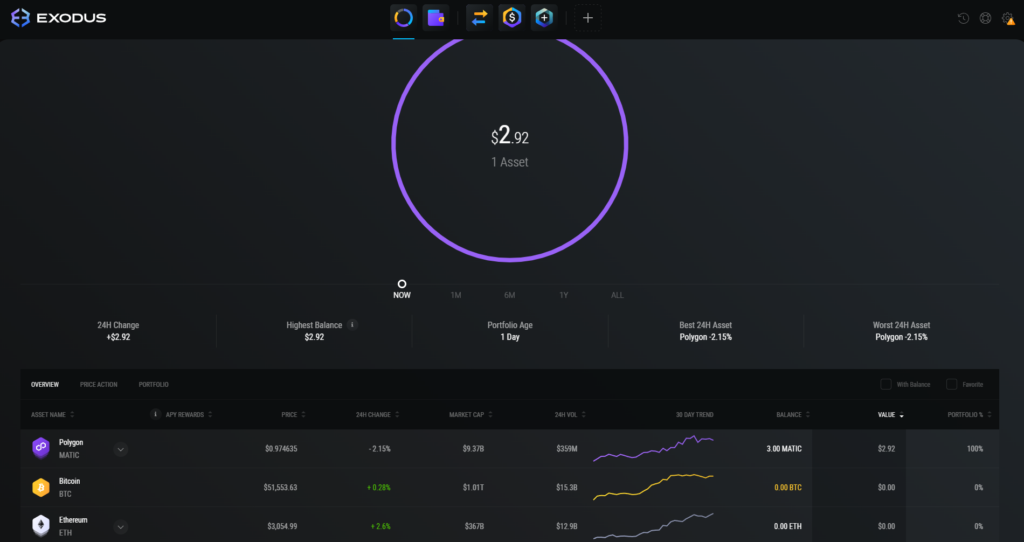
Exodus is an excellent crypto wallet for new users and those who just want a central location to manage their tokens across many different blockchains. The wide range of blockchain support, fiat on-ramp, and in-app swaps all in one spot make Exodus a strong contender as a web3 wallet of choice.
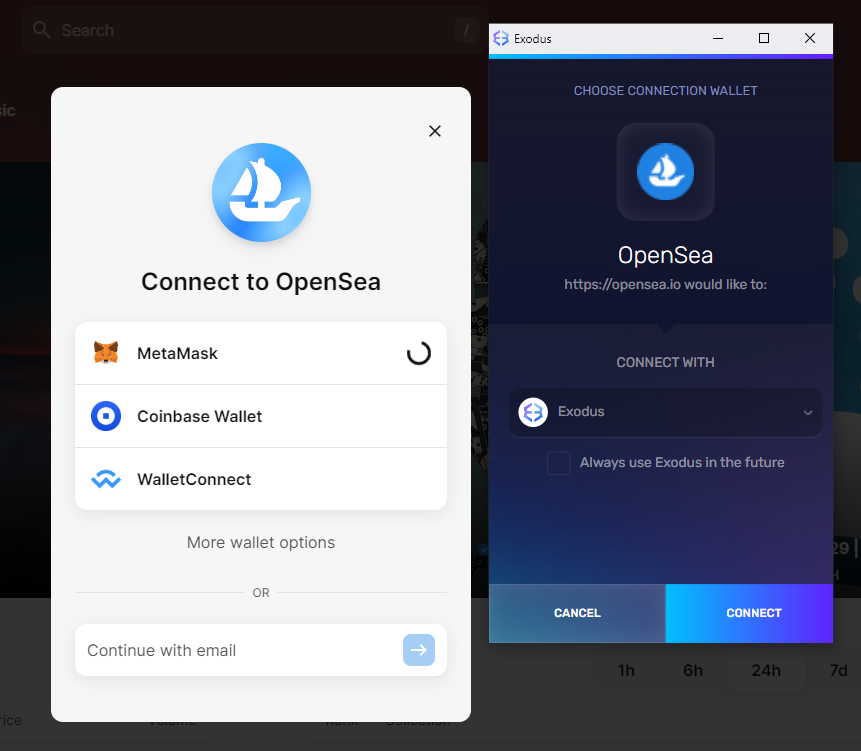
Exodus can connect to most sites that I tried, including OpenSea and Magic Eden. Interestingly, Exodus will even intercept calls to MetaMask, offering to be the login wallet instead. Which is great for sites that don’t offer Exodus-specific logins. But it’s not so great if you’re actually trying to use your MetaMask plug-in!
Installing and using Exodus was a breeze. I didn’t have any trouble with the desktop version, the mobile app, or the browser plug-in. Exodus supports easy syncing between devices with QR codes.
They also let you pair your Exodus wallet with your Trezor wallet. This feature gives users a convenient way to access their cold wallet while still maintaining the security and privacy offered by using a Trezor hardware wallet.
I took the time to check out some of the key features offered in the Exodus wallet and see how well they worked.
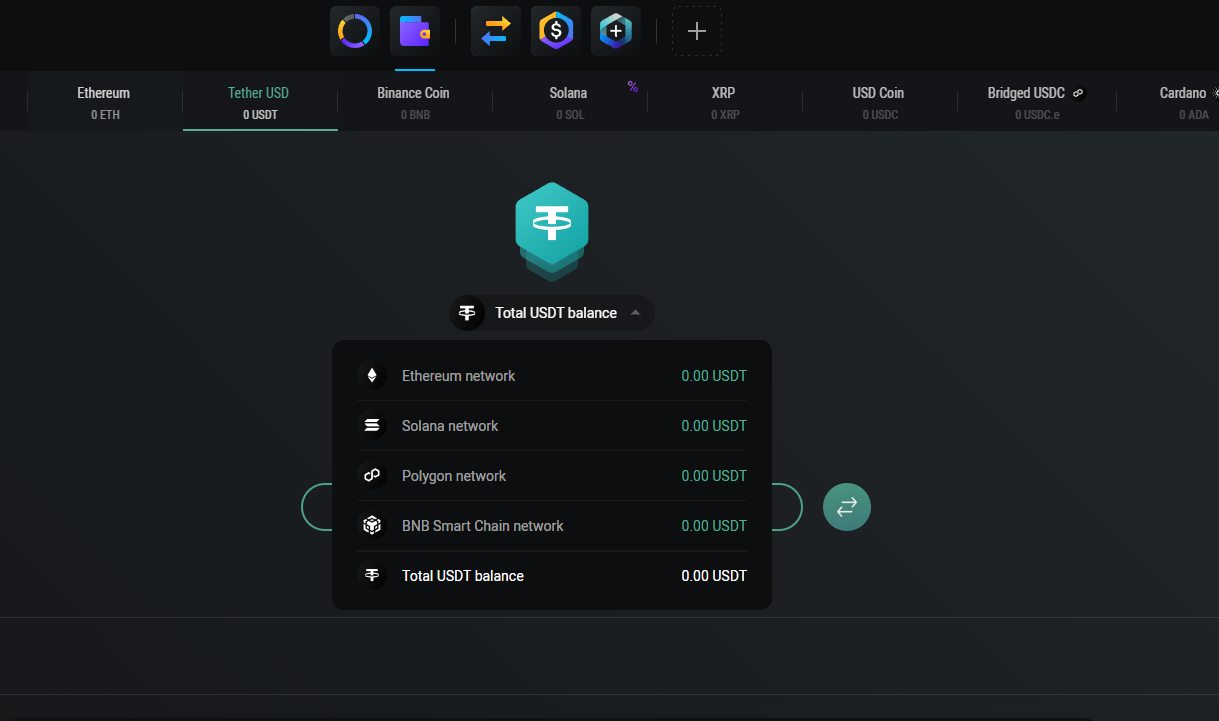
With its wide array of support for different blockchains, and a large number of tokens on those blockchains, Exodus can be a single, centralized location for all of your wallet needs. With the browser extension enabled, you can even connect to all of those different chains with one app!
Transferring tokens into your Exodus wallet will cost you a transaction fee based on the network used. For tokens that exist on multiple networks, Exodus will let you choose which network to use for your transfers.
At first, the ability to easily swap tokens in-app seems great. And it is a very useful feature. But, you will pay to use it. For one, Exodus charges a percentage of the amount swapped. This varies based on swap tokens, but it can be as high as 12%, which can be pretty significant! On top of that, you can’t swap directly between all tokens. There are about twelve main tokens that need to be on one side of the swap. And while this does provide extensive coverage, if you want to swap between two tokens that aren’t on the main list, you’ll have to do two trades instead, paying fees for both.
The swap interface itself is easy to understand. And all fees are calculated into the swap. So what you see as the output is what you will get. Also, the ability to swap tokens between chains (e.g. exchanging SOL tokens for tokens on the Ethereum network) is a nice feature.
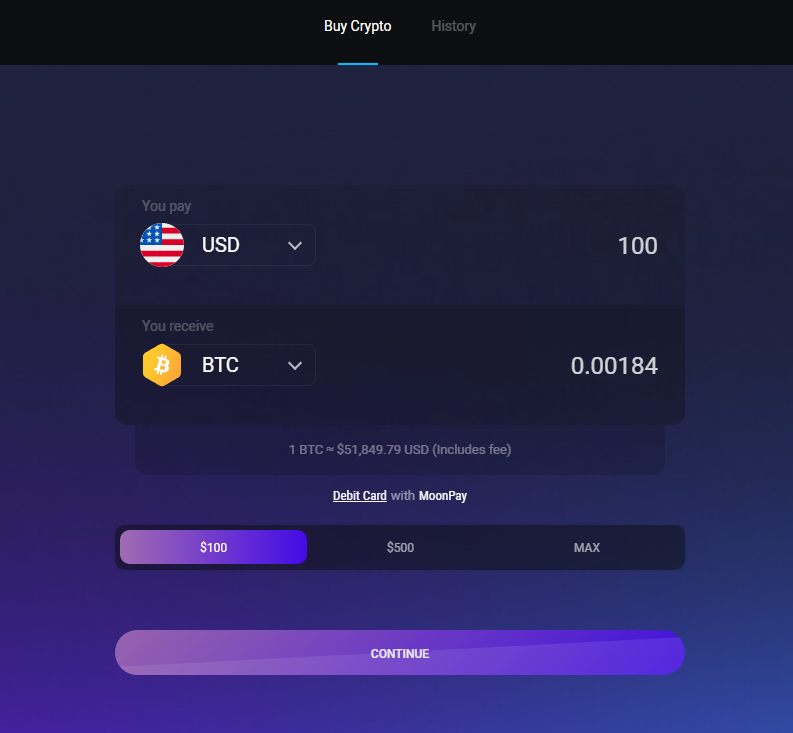
Exodus supports the in-app purchase of crypto in numerous different types of world currencies, including USD, EUR, GBP, AUD, and more. Purchases are made with Moonpay using a credit or debit card. Transacting with Moonpay happens through an off-app webpage, but any crypto purchased will appear directly in your Exodus wallet.
Exodus does offer a fiat off-ramp option through Moonpay. Though this feature is not available in some countries and some U.S. states.
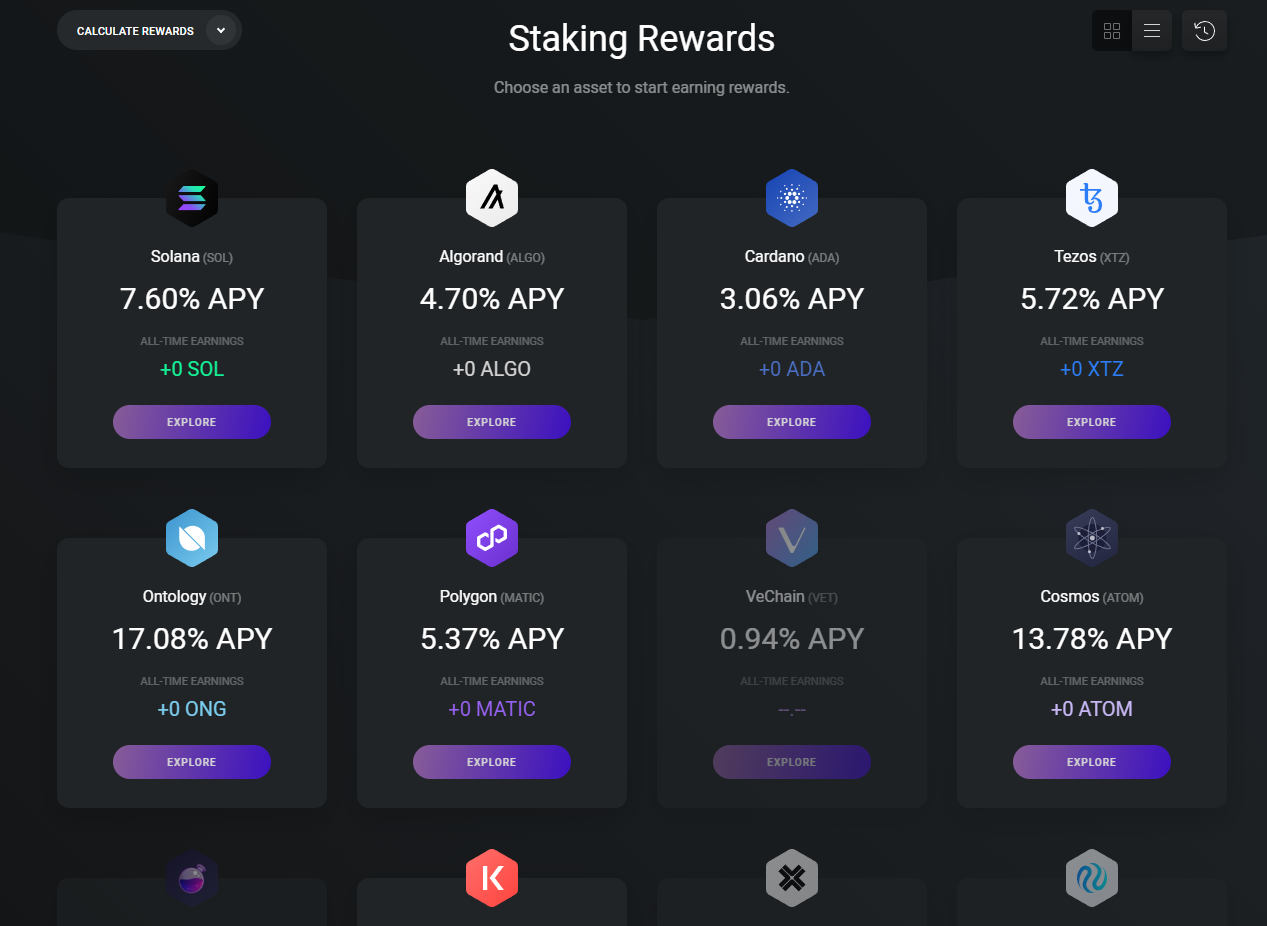
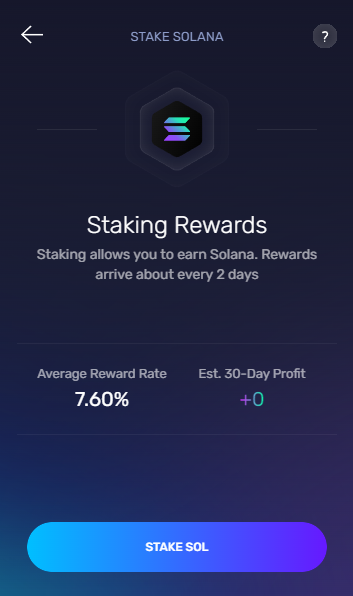
Users have the option of staking a dozen different cryptocurrencies through Exodus. Staking generally requires a network transaction fee depending on the token being staked. Some staking options also have minimum deposits and require an unstaking period. Thankfully, the Exodus wallet provides all this information for you upfront. Staking crypto through the Exodus wallet is a simple and seamless process.
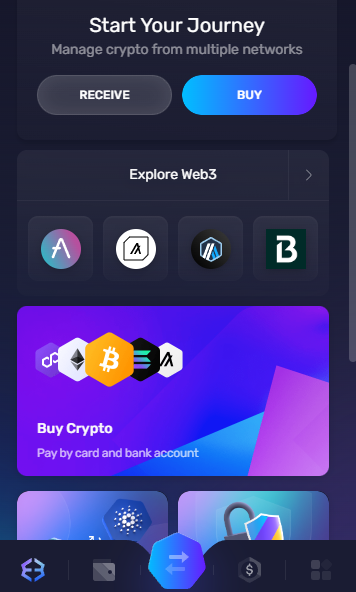
Exodus has downloads available for desktop apps (Windows, Mac, and Linux all supported), mobile apps on both Android and iOS devices, and a browser extension for Chrome / Brave. They mobile and desktop apps provide a nice, clean interface for accessing your wallet, as well as making in-app swaps and purchasing crypto. The browser extension also supports these features (though with a much smaller interface), well also letting you easily interact with web3-supported websites using your Exodus wallet.
Exodus includes a built-in knowledge base with answers to basic questions in their desktop and mobile apps. The knowledge base covers a wide variety of topics and should provide the answers for most of the basic questions about Exodus.
In addition, the Exodus YouTube channel has a number of educational videos about staking and other wallet features, as well as information about blockchain technology and specific coins.
Email support is accessible from all of the apps and the Exodus website at any time of the day or night. In my email support test, I sent them a basic question at 8:37am CST, and it took about 20 minutes until I received a non-automated response.
Exodus is for those who want to be able to easily buy coins and tokens with fiat and other crypto. Exodus is also great for those new to crypto. Their wide availability across devices, easy-to-use interface, and fiat on-ramp provide an excellent starting point for crypto newbies. Or those who just want an accessible, multi-chain wallet to help them store all of their accumulated coins and tokens.
Exodus is not for someone who already has existing wallets and is hoping to manage them in one spot. Though Exodus can serve that function, you have to first get your funds into your Exodus-created wallets. And while you can “import” with existing private keys, the import process actually transfers the funds from the imported address into your Exodus wallet address, which is not quite the same as using Exodus to access an already existing blockchain address.
Also, the fact that Exodus tried to get in front of calls to MetaMask can be kind of annoying if you have a MetaMask wallet that you use regularly.
Exodus certainly isn’t the only crypto wallet available. And it’s not the only one with multi-chain support. Let’s take a comparison look at a couple of Exodus’ more popular competitors and see how they stack up against each other.
Exodus and MetaMask are two of the oldest web3 wallets around. And though MetaMask began as a pretty simple wallet, they have grown over the past couple of years to include in-app swaps, token bridging, and fiat ramps. This brings their feature set in line with Exodus and even offers a little more flexibility. In addition, MetaMask allows access to several different service options for fiat on-ramp and off-ramps, where Exodus only connects to Moonpay.
However, Exodus has the advantage of user-friendliness. Their simple, but pleasing user interface will likely seem much more comfortable and familiar to those new to the crypto scene. And the ability to easily see your portfolio across several different chains in one spot is a nice feature for those who have their investments spread out widely.
| Supported Systems | Blockchains Supported | Additional Fees | Fiat Options | Trading Options | |
| Exodus | iOS and Android apps; Chrome / Brave plug-in; desktop wallet for Windows, Mac, and Linux | Bitcoin, Ethereum, Polygon, Solana, Algorand, Avalanche + many more | Network fees for all transactions; variable percentage fee for in-app swaps | Fiat on-ramp through Moonpay | Limited in-app swaps |
| MetaMask | iOSAndroidChrome extension | Ethereum, Polygon, Arbitrum, Optimism+ many more | Gas fees for network transactions0.875% swap and bridge feesAdditional fees for crypto purchases based on region and payment provider used | Fiat on-ramp and off-ramp available through several providers such as Transak, Moonpay, and Paypal | Swap between any two tokens on any supported chains; bridging between chains available as well |
Atomic Wallet and Exodus are very similar in many ways. They both offer a centralized location to manage tokens across multiple chains. They both are non-custodial (meaning only you have control over your private keys) and offer in-app swaps as well as fiat on-ramps.
Atomic Wallet offers more staking options, and the ability to swap between any supported tokens. Exodus offers a browser plug-in (which Atomic does not) and has a slicker interface. So the choice mostly comes down to personal preference, and if the app supports the blockchain and fiat options you need.
| Supported Systems | Blockchains Supported | Additional Fees | Fiat Options | Trading Options | |
| Exodus | iOS and Android apps; Chrome / Brave plug-in; desktop wallet for Windows, Mac, and Linux | Bitcoin, Ethereum, Polygon, Solana, Algorand, Avalanche + many more | Network fees for all transactions; variable percentage fee for in-app swaps | Fiat on-ramp through Moonpay | Limited in-app swaps |
| Atomic Wallet | iOS and Android apps; desktop app for Windows, MacOS, and Linux | Bitcoin, Ethereum, XRP, Litecoin + many more | Network fees for all transactions; 0.5% plus partners’ commission fee on swaps | Fiat on-ramp through Simplex | Swap between any supported tokens |
Exodus is a long-established player in the web3 wallet market. They have been around since 2015, which at this point, would be considered the early days of crypto.
Exodus is based in Nebraska, USA, and is a publicly-traded company (OTCPK: EXOD). The Exodus wallet has never suffered any publicly known hacks. As a non-custodial wallet solution, Exodus does not have access to your private keys.
The Exodus team releases a new update every two weeks, ensuring that any new vulnerabilities are patched promptly.
One knock against the Exodus Wallet is that it doesn’t support 2FA (two-factor authentication) security measures. But, due to the self-custody nature of the Exodus Wallet, two-factor authentication, would not prevent someone with your wallet’s secret recovery phrase from gaining access to your funds. Ultimate safety when using the Exodus wallet requires you to keep your recovery phrase, safe and secure.
Exodus’ support for a large number of cryptocurrencies and blockchains provides an enticing solution for those who need or want a centrally managed wallet. In addition, the availability of Exodus across different platforms and its simple but effective interface makes this wallet an excellent choice for newcomers as well.
For veteran crypto users, Exodus may not be a top choice. Or perhaps only as a secondary wallet option.
Their in-app swaps are more limited than I would like. And the high trading fees can be a put-off as well. As an established MetaMask user, I found the Exodus plug-in to be very annoying. I had to disable it in order to login to sites using MetaMask.
But overall, Exodus is an excellent multi-chain wallet and a fine choice for most users.
Exodus is a self-custody wallet. That means that only you have access to your twelve-word seed recovery phrase and your private wallet keys. And though this makes your crypto safe from outsiders, it also makes you responsible for your private keys and passphrase. Always be sure to write these down and keep them somewhere safe and offline. If you do keep these keys electronically as well, it’s best to encrypt the data rather than holding them in plain text files.
With the still-recent collapse of FTX, Celcius, and other crypto exchanges, concerns about companies going under and taking your crypto funds with them are certainly valid! But, since Exodus is a self-custody wallet, even if they go out of business, they cannot access your funds.
In addition, with your private keys, you can access your funds from outside of the Exodus apps. This allows you to retrieve your funds if something goes wrong.
Exodus was founded by JP Richardson and Daniel Castagnoli. JP Richardson has posted over 200 open-source libraries and written code used by blockchains today. Daniel brings a creative aspect to the project, having designed for companies such as Apple, BMW, Disney, Louis Vuitton, and Nike.
Exodus was founded in 2015.

BTCC Exchange Review 2026: Fees, Pros, Cons, & Safety
BTCC lets you trade crypto, gold, stocks, and more with up to an insane 500x leverage—and it’s been running since 2011 without a single hack.
🚨You can thank us later for this 👇 If you currently hold $BTC, $ETH, $SOL, $XRP, $BNB, $AVAX, $ADA and/or $BAT, you’re probably eligible for the Midnight ($NIGHT) airdrop. 👉 And claims will go live in the month of August, here! Putting crypto inside a Self-Directed IRA (SDIRA). “Ok, cool. I love an airdrop… but…
The Bottom Line: Bakkt (NYSE: BKKT) is an institutional provider of crypto services including custody and trading, as well as both crypto on-ramp and off-ramp services. Spun out of ICE, the parent organization of the New York Stock Exchange, Bakkt counts large brands like Webull & Caesars Entertainment among its clients. For large businesses and institutions looking to provide crypto services to their customers, Bakkt provides easy-to-integrate APIs and even ready-to-use UI for its products.
ProsCons
Review Score: 4.8/5
| Supported Assets | Availability | Safety Practices | Security Features | Regulatory Compliance |
| BTC, ETH, USDC, DOGE, ETC, SHIB, LTC, BCH | Ability to operate in all 50 states, Puerto Rico, and select regions internationally | No asset rehypothecation — all user assets are backed 1:1 $200 million insurance policy on funds under custody | SOC 1 Type 2 and SOC 2 Type 2 compliance Regular third-party audits and penetration testing 24/7 response support | Bakkt Trust is a Qualified Custodian by the NYDFS Bakkt has obtained a BitLicense from NYDFS |
As blockchain adoption hits critical mass and more institutions are taking crypto seriously, businesses need reliable partners in order to offer crypto services to their customers. It’s to this end that Bakkt was created. The platform offers institutions with easy crypto solutions for buying and crypto custody, trades, and on-ramps.
Bakkt was founded by the Intercontinental Exchange (ICE), the parent organization of the New York Stock Exchange, in 2018 and spun off into its own entity in 2021 (NYSE: BKKT). From inception, the platform has deep roots in institutional finance and checks all the boxes when it comes to regulatory compliance with a BitLicense from the New York Department of Financial Service (NYDFS) that allows it to operate a virtual currency business within the state of New York — a privilege granted only to a few dozen companies so far.
Beyond just trading and custody services, Bakkt is trusted by large brands including Caesars Entertainment and others for crypto-native reward programs. When it comes to user security, Bakkt has all its bases covered. The platform holds crypto assets in segregated wallets, using a combination of hot & cold storage, assets are never rehypothecated, and the custodian operates with a full 1:1 reserve at all times.
Bakkt originally launched with a split focus on retail and enterprise services but has since wound down its retail operations to focus exclusively on facilitating crypto rails for institutions and large brands. These services can be summarized into three main areas
Additionally, Bakkt offers several features and services to help their clients connect and utilize crypto in a variety of ways.
With a suite of crypto-related financial tools and services, Bakkt aims to deliver utility, security, and integration solutions to their clients. And as an institutional service, Bakkt takes their own security very seriously as well – always making sure that their customers’ investments are fully backed, and maintaining compliance with local regulations as well as regularly running their own audits and security checks.
One of Bakkt’s main services is its Trade program, which allows businesses of all types and sizes to easily integrate crypto on-ramps for their users. Through Bakkt® Trade, businesses can offer their users the option to buy, sell, and store crypto right from their website or app — powered by Bakkt’s API. Available in all 50 states and select international regions, Trade facilitates the ability to deliver crypto to end-users.
Bakkt features institutional-grade custody services and regulatory compliance that provides businesses and users alike with peace of mind. When it comes to anti-money laundering, Bakkt goes a step further with their tools for blockchain analysis and fund tracking which ensures all crypto flowing through your business is clean. Bakkt is also very particular about what cryptocurrencies they work with; according to their website they “prioritize security, regulation, and long-term sustainability” when selecting what coins to offer.
Bakkt® Custody is one of the most well-regulated custody services available to institutions today. As a “Qualified Custodian” under the New York Department of Financial Services (NYDFS), Bakkt splits customer funds between software (“hot”) wallets and hardware (“cold”) wallets, provides a team of custody experts available 24/7, and operates an environment compliant with SOC 1 and SOC 2 Trust Services Criteria.
Bakkt emphasizes compartmentalized custody, highlighting that all the crypto they custody is always held on behalf of the user and “never used for lending, pledging, or any other similar purposes.” This is an important point as secondary lending of crypto has been the culprit in high-profile crashes like that of FTX.
Finally, Bakkt’s hardware wallets are held in biometrically secure facilities, and all client funds are insured under a $200 million insurance policy.
Due to Bakkt’s nature as a bespoke enterprise product, customer service for non-customers is limited to filling out a contact form on the company’s website.
For Bakkt’s clients, there is 24/7 technical and operational support through various ways. Bakkt has support email addresses for each product, a dedicated partner support function, as well as a self-service marketing portal to help clients activate. End users looking for help with their crypto can also contact support at [email protected].
Bakkt is an all-in-one package facilitating crypto trading, custody, and other services, but it’s not the only reputable crypto rails service out there. Below we take a look at some other options and compare how Bakkt stacks up.
ZeroHash is a crypto infrastructure company that provides clients with crypto trading, custody, payments, & loyalty rewards services — similar to Bakkt. Where it stands out is in its vast support for a wide range of cryptocurrencies (over 65) and blockchains (22 different chains). However, Bakkt edges ZeroHash out in big-name partners and regulatory compliance.
| Platform | Supported Assets | Services Offered | Partners | Unique Features | Security |
| ZeroHash | 65+ digital assets | Trading Custody Services Payments Loyalty Programs | Stripe MoneyLion Draft Kings | On-Chain Settlement Support for 22 blockchains as well as NFTs | SOC Type 2 ISO/IEC 270001:2013 Vulnerability Disclosure Program |
| Bakkt | BTC, ETH, USDC, DOGE, ETC, SHIB, LTC, BCH | Custody Trade On-ramps | Public Webull Pay Hapi | Provide ready-to-use UIs for their products Public company highly compliant with NYDFS | SOC 1 and 2 Type 2 compliant $200 million custody insurance fund NYDFS Qualified Custodian |
NYDIG is an institutional crypto provider that specifically focuses on Bitcoin transactions. For businesses looking to provide Bitcoin services to their customers, NYDIG provides a range of options including borrowing & lending as well as a Bitcoin savings plan for employees. Businesses interested in more than just Bitcoin, however, may find Bakkt a better partner.
| Platform | Supported Assets | Services Offered | Partners | Unique Features | Security |
| NYDIG | Bitcoin only | Invest & Trade Borrow & Lend Bitcoin Savings Plan | New York Yankees Deloitte US Bank | Large focus on Bitcoin custody and services | SOC 1 Type 2 and SOC 2 Type 2 compliant Audited by a multinational professional services firm |
| Bakkt | BTC, ETH, USDC, DOGE, ETC, SHIB, LTC, BCH | Custody Trade On-ramps | Public Webull Pay Hapi | Provide ready-to-use UIs for their products Public company highly compliant with NYDFS | Current SOC 1 and 2 Type 2 reports $200 million custody insurance fund NYDFS Qualified Custodian |
Due to the ever-changing nature of crypto, we cannot accurately say how safe and secure a product is now or will be in the future. We have examined a variety of factors to determine how safe we believe Bakkt is, but please use caution and always get a sense of the platform yourself. Below we examine a list of factors that contribute to the security of Bakkt and the crypto solutions they provide to businesses.
Largely thanks to its roots with ICE, Bakkt takes security and regulatory compliance seriously. The provider does not rehypothecate or lend out any funds under custody. All customer crypto is kept in a separate trust entity regulated by NYDFS and all assets are fully backed 1:1.
Bakkt uses an NYDFS-approved Coin Listing Policy to choose which assets to list on its platform. This policy provides guidance on best practices for selecting and listing cryptocurrencies on platforms such as Bakkt.
The platform is also SOC 1 Type 2 and SOC 2 Type 2 compliant and undergoes annual third-party penetration testing. Bakkt continuously maintains their security practices through teams dedicated to upholding security and compliance programs. These teams include an Internal Audit department and an Enterprise Risk department.
Bakkt was founded in 2018.
Initially formed under the Intercontinental Exchange (ICE), Bakkt spun out into its own company in 2021. Bakkt is now a publicly traded company on the New York Stock Exchange.
At the time of its public listing in 2021, Bakkt had raised $448M, according to Crunchbase.
Bakkt went public via SPAC at a valuation of 2.1 billion dollars. Its former parent organization, ICE, retains a 65% stake in the public company.
Bakkt has the ability to operate in all 50 states, Puerto Rico, and select regions internationally.
When it comes to regulatory compliance, the crypto provider is licensed as a Qualified Custodian under NYDFS and has obtained a BitLicense.
Bakkt is a crypto infrastructure company that provides large businesses and institutions with crypto custody, trading, and on-ramps. The platform’s user-friendly APIs and their pre-made UI front-ends make integrating these products an easy and straightforward process for all types of businesses. As a spinoff of ICE, Bakkt’s extensive regulatory compliance makes it a good choice for companies who want to make sure their crypto products are fully compliant.
Bakkt provides crypto services and solutions that are relevant for institutional digital asset management as well as enabling businesses that want to provide crypto to their customers
Businesses integrate Bakkt’s services into their website or app through an API, and Bakkt handles all the backend work for crypto trading, custody, and more, offering B2B2C & B2B Solutions.
Following a client’s request for fund withdrawal, Bakkt support reviews the request and sends the funds.
Clients are notified via email once a request goes through, though newly whitelisted addresses may experience a 48-hour holding period.
The full list of supported assets are BTC, ETH, USDC, DOGE, ETC, SHIB, LTC, & BCH
Bakkt is a public company traded on the New York Stock Exchange under the ticker symbol BKKT.
The company was originally formed as a part of Intercontinental Exchange, Inc. (ICE), the parent organization of the New York Stock Exchange. ICE retains a 65% stake in the publicly traded Bakkt corporation.
BTCC Exchange Review 2026: Fees, Pros, Cons, & Safety
BTCC lets you trade crypto, gold, stocks, and more with up to an insane 500x leverage—and it’s been running since 2011 without a single hack.
🚨You can thank us later for this 👇 If you currently hold $BTC, $ETH, $SOL, $XRP, $BNB, $AVAX, $ADA and/or $BAT, you’re probably eligible for the Midnight ($NIGHT) airdrop. 👉 And claims will go live in the month of August, here! Putting crypto inside a Self-Directed IRA (SDIRA). “Ok, cool. I love an airdrop… but…
Stryke (formerly known as Dopex) is a decentralized options exchange focusing on calls and puts across Arbitrum and Polygon. As a result of its clever derivatives products, the protocol markets itself to traders with a healthy risk tolerance. In addition to a wide range of options vaults, Stryke offers advanced speculation instruments, including concentrated liquidity options and synthetic yield-bearing tokens. As a crypto-native one-sentence summary, Stryke was created by degens for degens.
ProsCons

| Supported Assets | Flagship Products | Supported Chains | Restricted Jurisdictions | Security Features |
| WBTC WETH stETH ARB SYK xSYK GMX CRV CVX MATIC BOOP | Weekly and monthly option vaults Concentrated liquidity options | Arbitrum Polygon | The US | Audits by Solidified and Sourcehat |
Stryke is a decentralized options exchange that offers a variety of crypto options and yield-bearing products.
Users can buy and sell monthly or weekly calls and puts for a variety of assets, including BTC, ETH, ARB and others. The protocol also recently introduced the “Concentrated Liquidity Automated Market Maker” (CLAMM) product, which combines the enhanced yields of Uniswap v3-style concentrated liquidity pools with crypto options.
We’ve covered options trading in the past here on Milk Road, but let’s do a quick recap, as Stryke requires a good grasp of options theory.
Options are a type of derivative contract. This means that options derive their value from some underlying asset. In traditional finance, this underlying asset is usually a stock, while in crypto, it’s usually a cryptocurrency such as BTC or ETH.
Options give buyers the right, but not the obligation, to buy or sell an underlying asset at a predetermined price (strike price) before or at a certain date (expiration date). There are two types of options: “calls” grant the right to buy the asset at a particular price in the future, while “puts” grant the right to sell the asset at a particular price in the future.
For example, let’s say I buy a call option for ETH. This allows me to buy ETH at a certain locked-in price in the future, regardless of what the actual price of ETH is at that time.
In this example, let’s say I buy a call option to purchase ETH for $2,000 two months from now. The $2,000 is known as the “strike price,” while the exact date two months from now is known as the “expiration date” of the option. I also pay a fee, known as the “option premium,” to buy the right (but not the obligation!) to purchase ETH for $2,000 on a specific date two months from now. Puts work in reverse, allowing me to sell an asset like ETH for a fixed price at some future time, regardless of the market rate.
The option buyer pays a premium for reserving the right to purchase or sell the asset for a fixed price at some future time. This option premium, in turn, gets paid to the option seller for the service of selling or writing the option.
In essence, options are a two-sided bet, with buyers betting that the future price of the asset will compensate for the option premium they paid and sellers collecting the option premium upfront and betting that the option won’t need to be exercised.
Options expire either “in the money” or “out of the money,” determining whether the option is profitable to exercise for the buyer.
In short, buyers hope that, at expiration, options are “in the money,” and they can exercise them and either buy or sell an asset for a better price than the market rate, while sellers hope that options are “out of the money” and they get to collect the option premium from the buyer without having to lose out on the opportunity cost of the asset.
Stryke is a decentralized exchange for trading cryptocurrency options.
Decentralized crypto options work a bit differently from traditional options and even crypto options on centralized exchanges (like Binance). Traditional options use an “orderbook” trading model, where individual traders take both sides of the options bet — meaning someone buys an option with a defined party on the other side selling that option to them.
In decentralized options, on the other hand, users who want to sell options deposit assets into a pool, earning an aggregated yield from the premiums this pool collects. Option buyers, in turn, purchase options that are underwritten by the assets in this pool and pay their option premiums into the pool as a whole.
This is the model that Stryke uses. Below, we take a look at some of the flagship products and features the exchange supports. It’s also worth noting that Stryke is currently undergoing a major overhaul. After initially launching as the first decentralized options exchange on Arbitrum a few years ago, Stryke is progressively rolling out a v2 that includes features like the CLAMM and major improvements across other products.
Let’s dig in.
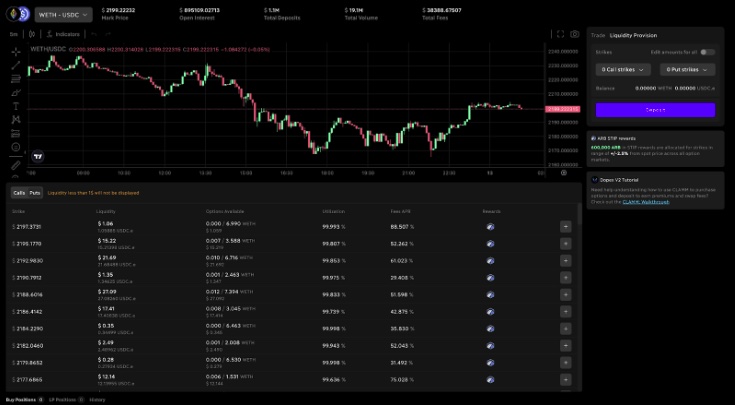
One of Stryke’s most unique products is the “Concentrated Liquidity Automated Market Maker” (CLAMM.) This one takes a bit of explaining, so hold on tight to your milk and cookies.
Beginning with Uniswap v3, the world of DeFi was introduced to concentrated liquidity. On decentralized exchanges like Uniswap, users can provide liquidity by depositing various crypto tokens. This allows others to trade assets using the deposited liquidity while the depositors (known as liquidity providers) earn yield on their deposited tokens.
Concentrated liquidity is an innovation that allows users to provide liquidity within a certain price range. This “concentrates” their liquidity and allows for higher yields as long as the price of the asset stays within this predefined range.
The CLAMM brings concentrated liquidity to options trading. Here’s how it works.
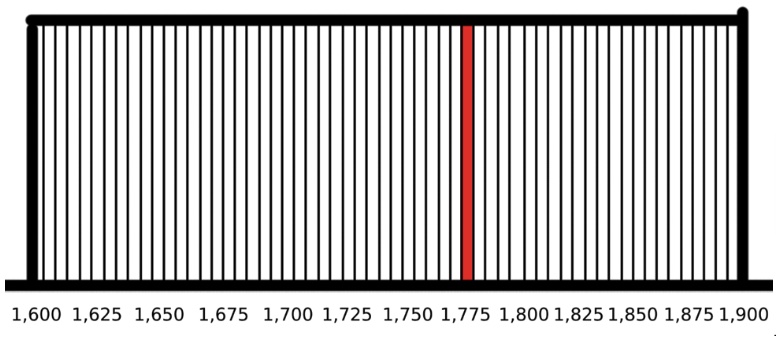
Buyers deposit liquidity for an asset, such as ETH, buying up “ticks” that represent slices of concentrated liquidity. In the image above, you can see that the red tick represents prices between about $1,775 and $1,780. If you deposit liquidity into this tick, you will earn yield whenever the price of ETH is within this narrow range.
Each tick has a different yield rate depending on market conditions, and you can purchase multiple ticks (adjacent or nonadjacent) to ensure that you are continuously earning yield as the market price moves up and down.
So, you’re able to deposit concentrated liquidity within a narrow price range and earn enhanced yields as long as the price of the underlying asset is within this range. Where do options come in?
It turns out that you can buy and sell these ticks, and their payoffs act just like options. As the price of an asset fluctuates, you earn more or less depending on how you set up your liquidity-providing strategy, just like how your option payout varies depending on market prices.
Stryke has recently expanded by partnering with Pancake Swap and SushiSwap to have their CLAMM options available on those platforms.
That’s as much as we’ll be able to get through here without filling up 10 whole pages with explanations, but you can learn more about how the CLAMM works through Stryke’s official CLAMM guides.
As far as supported assets go, all CLAMM markets are denominated in the stablecoin USDC and one of three crypto assets: WBTC, ETH, and ARB.
SYK is Stryke’s token. It has a max supply of 100 million, with about half of that currently circulating. Though the token contract is based on the Arbitrum One chain, SYK is planned as a cross-chain token, facilitating migrations and liquidity across various chains.
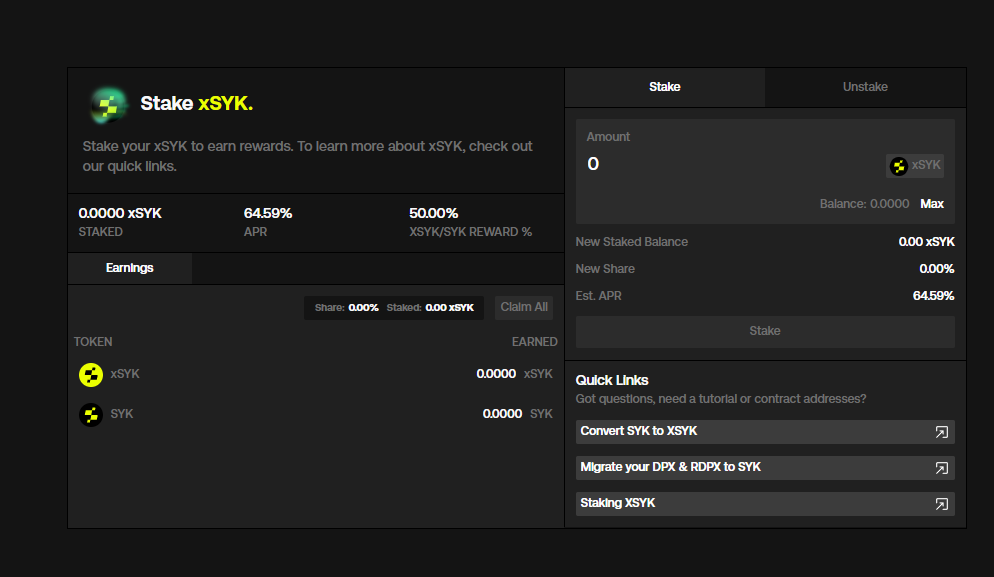
Holders can lock their SYK tokens into vested escrow contracts and receive xSYK on a 1:1 basis. To incentivize long-term investors, users will need to vest their xSYK tokens for at least seven days. But, even at that point, you will only receive 50% of your SYK tokens back if you try to convert your xSYK. To receive your full investment back, you will need to hold those xSYK tokens for at least six months.
But there are reasons to hold onto those tokens. Holding xSYK tokens allows for participation in the governance and voting of the Stryke platform. Additionally, locking up SYK generates rewards in the form of SYK and xSYK tokens. Yields come from trading fees.
As a decentralized protocol, Stryke relies on community channels like Discord, Telegram, and WhatsApp to provide assistance and answer questions.
I contacted the team by opening a ticket through Discord, and it took a while for me to receive an answer, so your best bet may be to message them across multiple channels to make sure you receive assistance.
Decentralized derivatives exchanges have gained significant traction during the bull market. Below, we take a look at several of the popular alternatives to Stryke and compare how they stack up.
dYdX is the most popular decentralized derivatives platform by trading volume. While Stryke focuses on options, dYdX’s main offering is perpetual futures — a type of derivative that does not have an expiration date and is commonly used for leveraged price speculation.
On the other hand, dYdX does not offer advanced derivatives features like concentrated liquidity options and advanced synthetic assets that can be chained together for enhanced yield the way Stryke does.
| Supported Assets | Supported Chains | Standout Features | |
| dYdX | WBTC WETH SOL AVAX LINK ATOM OP ADA + more | dYdX Chain | The decentralized perpetual futures exchange with the most liquidity dYdX v4 is built on a proprietary blockchain that makes trading more efficient |
| Stryke | WBTC WETH stETH ARB SYK xSYK GMX CRV CVX MATIC BOOP | Arbitrum Polygon | Advanced options yield strategies through special vaults and concentrated liquidity Synthetic assets for advanced yield farming |
GMX is another popular decentralized derivatives platform. Though it mainly focuses on perpetual futures, GMX also provides a number of yield-bearing tokens, similar to Stryke , that users can leverage to earn yield.
Like Stryke , GMX is available on L2 chains like Arbitrum. Where Stryke has markets for Polygon, however, GMX has Avalanche markets.
| Supported Assets | Supported Chains | Standout Features | |
| GMX | WBTC WETH SOL LINK XRP UNI DOGE + more | Arbitrum Avalanche | Leverage up to 50x on base assets Rewards for holders and stakers of the GMX token that come from protocol fees |
| Stryke | WBTC WETH stETH ARB SYK xSYK GMX CRV CVX MATIC BOOP | Arbitrum Polygon | Advanced options yield strategies through special vaults and concentrated liquidity Synthetic assets for advanced yield farming |
Due to the ever-changing nature of crypto, we cannot accurately say how safe and secure a product is now or will be in the future. We have examined a variety of factors to determine how safe we believe Stryke is, but please always use caution and thoroughly investigate the platform for yourself before using it.
One of the most important factors when it comes to assessing the security of a decentralized protocol is whether they have completed audits of their codebase. Stryke has received several audits that find no major issues with the protocol, so this is a good sign for the overall safety of the protocol.
The anonymity of the team behind the exchange may raise some questions, however Stryke has been live since 2017, and the team has since proven that they are invested in the long-term success of the protocol.
Stryke is built by an anonymous team that mostly communicates through their crypto-Twitter handles.
The most prominent figurehead of Stryke is known as “TzTok-Chad” on Twitter, where they tweet about all things Stryke, like the protocol developments and the product roadmap.
Yes, Stryke has undergone several audits by notable companies including Solidified and Sourcehat. Recent audits include one by yAudit for their CLAMM offering.
Stryke is an innovative options exchange that supports several flagship products and provides yield in inventive ways. For traders with a risk appetite, Stryke allows speculation across various options, products and synthetic tokens.
The anon status of founders, while common in crypto, may give some potential investors pause, and the protocol keeps a pretty tight grip on new features, with no avenue for the community to get involved in governance currently.
Still, Stryke promises enough yield-bearing debauchery for even the most seasoned degen.
Stryke is a decentralized options exchange that allows advanced traders to make bets on crypto options and synthetic assets.
Users can buy or sell call and put options and provide concentrated liquidity for options. Stryke is live on the Arbitrum and Polygon networks and supports major assets like BTC, ETH, ARB, and GMX.
Yes, you can make money trading crypto options, but keep in mind that options are considered very risky, and they require some time to fully grasp.
Crypto options allow traders to make bets on asset price movements by buying and selling calls and puts, which are the rights to buy or sell assets for a fixed price at some future date. Options are inherently speculative as they deal with future price movements, so traders should be very cautious when getting involved in these types of markets.
SYK is the primary token of the Stryke ecosystem. It’s used to incentivize liquidity providers, and it can be locked up to receive xSYK, a governance token that unlocks voting rights so holders can help decide the future of the protocol.
BTCC Exchange Review 2026: Fees, Pros, Cons, & Safety
BTCC lets you trade crypto, gold, stocks, and more with up to an insane 500x leverage—and it’s been running since 2011 without a single hack.
🚨You can thank us later for this 👇 If you currently hold $BTC, $ETH, $SOL, $XRP, $BNB, $AVAX, $ADA and/or $BAT, you’re probably eligible for the Midnight ($NIGHT) airdrop. 👉 And claims will go live in the month of August, here! Putting crypto inside a Self-Directed IRA (SDIRA). “Ok, cool. I love an airdrop… but…
The WebAuth Wallet has carved out a unique spot for itself, utilizing its native XPR blockchain to support cryptocurrencies across a number of different blockchains. Featuring gas-free transfer with their wrapped tokens and a system where wallet addresses are just simple text names, WebAuth has created a very user-friendly experience.
Users do need to first bridge their tokens from other blockchains onto the XPR chain, but once you get past that hurdle, WebAuth wallet provides a smooth interaction with all of the supported tokens, no matter their native chain, and provides a seamless connection to Metal X, a feature-rich, decentralized trading platform with a professional style interface.
ProsCons
| Supported Systems | Fees | Supported Tokens | Trading | Staking | Availability |
| Android, iOS | Zero transfer fees Blockchain fees required when transferring crypto onto and out of the XPR network | Bitcoin, Ethereum, Litecoin, Solana, Polygon, many more! | Seamless connection to native, decentralized exchange with swaps and other services | Available in over 160 countries, including the U.S. | Available in over 160 countries, including the U.S. |
WebAuth wallet is a mobile cryptocurrency wallet that allows holding many of the more popular crypto tokens in one place, regardless of their native blockchain. Built on the XPR Network, which was formerly known as Proton, the WebAuth wallet was created specifically to take advantage of the trading and financial focus of the XPR blockchain, which supports instant transactions with zero gas fees.
Utilizing wrapped tokens on the XPR network, the WebAuth Wallet allows deposits of Bitcoin, Ethereum, Solana, Stellar, Dogecoin, and many more cryptocurrencies from a wide variety of blockchains. These wrapped tokens let the WebAuth wallet make sending, receiving, and trading with cryptos an easy and free experience.
With a linked trading service known as Metal X, users of the WebAuth Wallet can take advantage of those zero-fee transactions while trading, staking, and swapping their crypto all in one place.
The WebAuth Wallet wants to be the wallet that does everything. And while they may not be quite there yet, they have already made a good start! Here are some of the key features of this multi-chain crypto wallet.
The WebAuth Wallet doesn’t charge any fees for sending or receiving crypto within the XPR network.
However, users will need to pay gas fees to transfer crypto into and out of the WebAuth wallet, but that’s based on whatever network fees are charged by the blockchain where the tokens are coming from or being sent. Once your crypto is in the WebAuth wallet, all transfers within the XPR network are completely free of charge!
You will also need to pay any fees charged by the other platforms you use (such as trading fees), but moving your crypto around on the XPR network is free with the WebAuth Wallet. This includes sending it to other accounts.
The WebAuth wallet offers a lot of nice features, especially for users looking for one wallet to help them manage their crypto across several different blockchains. Installation and setup are stress-free. To start a new wallet, you just need to create an account name, which will also function as your wallet address, save your seed phrase, pick a PIN number, and verify your email address.
WebAuth is available in over 160 countries, including the U.S. The WebAuth Wallet team has also gone out of their way to work on complying with any and all state-specific regulations, making sure that their wallet is available to as many people as possible.
With the number of blockchains continuing to grow and many of them gaining steam in regard to development and utility, having a single wallet to manage tokens across multiple chains is an increasingly useful feature. The WebAuth wallet supports deposits and withdrawals across a number of blockchains.
However, the need to first transfer your tokens onto the XPR network is kind of awkward and not something that everyone will be willing to do. Add a required KYC process on top of that, and the WebAuth wallet may push away many old-school crypto users.
And though it’s not directly in-app, the integrated Metal X dex makes crypto trading and staking a simple process, all in one spot.
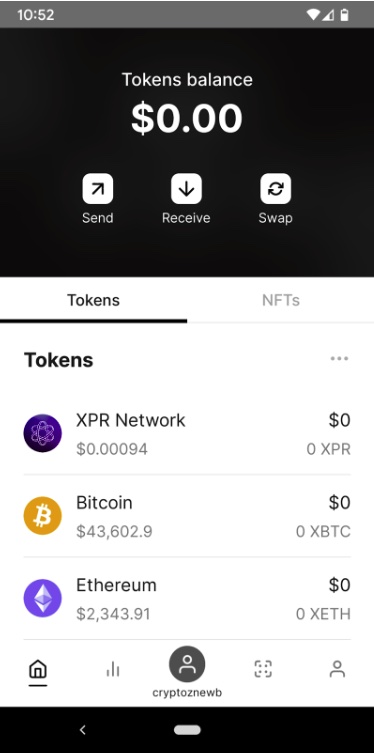
The interface for WbeAuth Wallet is simple and easy to understand. It includes information about the crypto in your wallet, as well as current prices for all supported cryptocurrencies.
Information on the current market state, swaps, trades, sending and receiving are all only a click away. All of the screens are clean, easy to read, and easy to navigate.
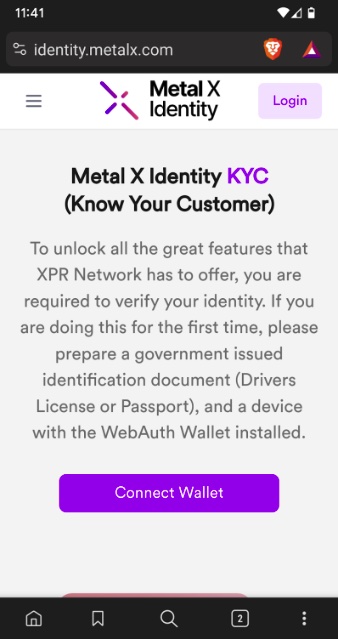
In order to really get started with WebAuth Wallet, you will need to complete a KYC or Know Your Customer process.
Having your identity verified requires connecting to an external site and taking photos of your driver’s license or passport as well as entering your home address. I was unable to get this process to work using the Brave Browser, even with the shields down. But once I switched to Chrome, the process was pretty smooth overall.
The KYC access comes in two stages. The first stage opens up deposits from external wallets, which is pretty much required unless you already have someone sending you wrapped tokens on the XPR network. Verification in this first stage can take up to 24 hours.
Then, if you want to go a step further, you can provide your Social Security Number, which allows for purchases with fiat and provides access to the loan feature.
Installation of the WebAuth wallet was an easy and smooth process. The app can be found and installed from the Apple Store and Google Play Store. You will need to let your mobile browser access your camera while verifying your identity.
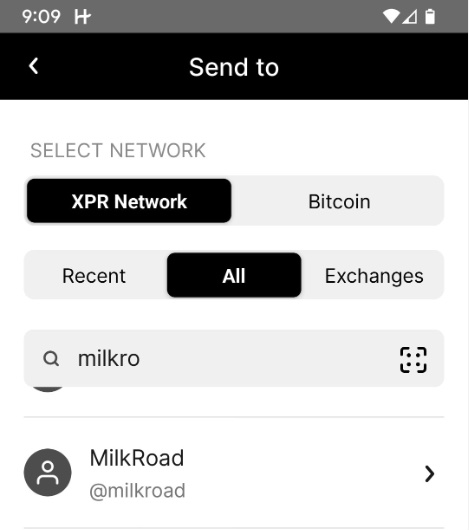
Sending and receiving crypto with the WebAuth wallet is simple as well. And with text-based wallet addresses, there is no need to copy and paste a bunch of long, difficult-to-memorize address strings. You can send any of the supported tokens to another user using just one text address.
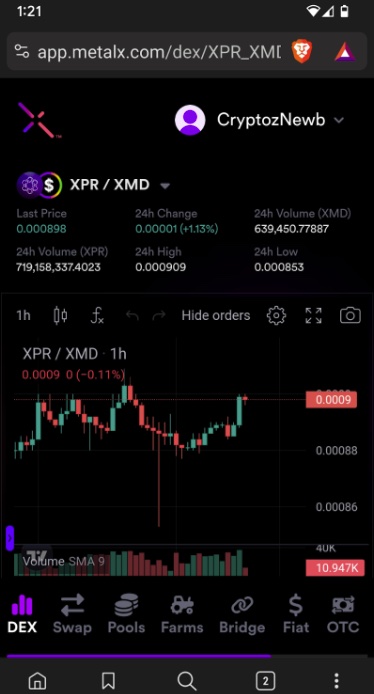
WebAuth Wallet connects to Meta lX, the native app that is a one-stop shop for all trading. This includes a decentralized exchange with a dozen trading pairs, a swap feature for all of the wrapped tokens on the network, liquidity pools, farms, an asset bridge, a fiat on-ramp, and even a section for OTC trades! The interface for all of these features looks great, and the functions are easy to use.
WebAuth wallet offers a searchable knowledge center and customer service via email. Customer service was very responsive to my email inquiry, responding within about 10 minutes.
Now, of course, WebAuth wallet is not the only option for crypto wallets. Two of the most popular, Exodus and Metamask, each offer a slightly different experience from WebAuth wallet. Let’s do a side-by-side comparison to see some of the similarities and differences.
Another popular multi-chain wallet is Exodus. Both Exodus and WebAuth support multiple blockchains, allow cross-chain swaps, and support fiat purchases. Both are also non-custodial wallets, giving you complete control over your private keys and full access to your crypto.
| Supported Systems | Blockchains supported | Additional fees | Fiat options | Trading options | |
| WebAuth Wallet | iOS, Android | Bitcoin, Ethereum, Stellar, Litecoin, Solana, and more | No fees for transfers | Credit / debit card | Swaps, dex, pools, farms, and OTC trades all supported through Metal X |
| Exodus Wallet | Chrome extension | 15+ Networks including Ethereum, Solana, BSC | No transfers; small fee for swaps | credit/debit card, bank account, Apple Pay, or Google Pay | In-app swaps through third parties |
One of the most popular crypto wallets of all is MetaMask, a longtime contender that has expanded over the years to include additional features and chain support. MetaMask can access a wide variety of blockchains, but it doesn’t allow you to commingle funds from different chains, and it doesn’t support swaps with tokens across different chains. MetaMask is also a non-custodial wallet.
| Supported Systems | Blockchains supported | Additional fees | Fiat options | Trading options | |
| WebAuth Wallet | iOS, Android | Including Bitcoin, Ethereum, Stellar, Litecoin, Solana, and more | No fees for transfers | Credit / debit card | Swaps, dex, pools, farms, and OTC trades all supported through Metal X |
| MetaMask | Chrome extension | Ethereum, Polygon, Arbitrum, Binance | Blockchain fees when making transfers; | Credit / debit card, PayPal, bank transfer, wire transfer | In-app swaps through third parties through 3rd party services; cash out with PayPal |
Safety is of paramount importance for anyone’s finances. And unfortunately, it’s impossible to give a definitive guarantee of safety for any product. But there are some factors you can take into account to mitigate your risk. This includes not only the security claims from the product team but also the company’s history and their regard in the general community.
WebAuth wallet uses the standard 12-word keyphrase when creating new accounts. These keywords are vital! Don’t lose them, and don’t ever give them to anyone else! WebAuth wallet also supports device biometrics such as fingerprint or facial recognition authorization. If you have them turned on for your mobile device, then you can also enable the biometrics for WebAuth through the wallet settings.
Now, of course, none of this security matters if you can’t trust the creators of the app. So here’s a little more information about Metallicus, the creators of the WebAuth wallet, and the entire XPR network.
WebAuth Wallet was developed and run by a group called Metallicus, which was founded by Marshall Hayner and Glenn Mariën.
Marshall Hayner has been involved with several crypto-related projects, including Stellar and the creation of the first Facebook Bitcoin wallet. He is also a board member of the Dogecoin Foundation.
Glenn Mariën, a full-stack developer, also worked on Dogecoin, creating Dogechain.info, the first online wallet for Dogecoin.
Metallicus, creator of the WebAuth wallet, was founded in 2016 and is headquartered in San Francisco, California, United States.
With a focus on bringing the financial future to the blockchain, Metallicus has built a large team of experienced professionals, including an advisory board of banking executives and former governmental leaders.
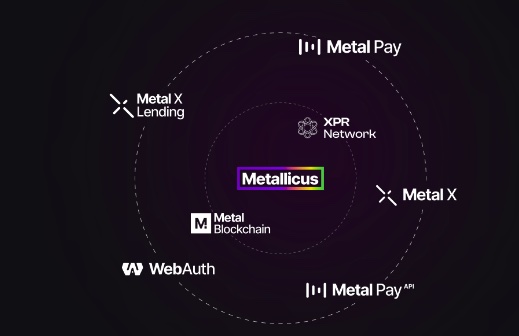
Metallicus is the organization behind the XPR network itself, as well as MetalPay, a fiat on-ramp, Metal X, an all-in-one decentralized exchange and financial hub, and the WebAuth wallet.
Multi-chain wallets are increasingly common these days. In fact, they likely outnumber single-chain wallets at this point! The WebAuth Wallet looks to claim its spot among this next generation of wallets. Their blockchain support is on par with their competitors, and the app is as simple and easy to use as anything else on the market.
Their ability to offer zero-fee transfers and simple swaps between blockchains is certainly an appealing feature. But the requirement to bridge all of your assets over first and the need to participate in a KYC process before you can really get started may be unappealing for some users.
With WebAuth Wallet’s support for a number of different blockchains, an integrated financial system that supports pretty much all of your trading needs, and the ability to easily swap between different cryptos, WebAuth will certainly be an attractive option for many users.
XPR Network is a layer 1 blockchain that was formerly known as Proton Chain. After a rebranding in 2020, XPR Network has built itself as a blockchain geared for heavy financial use, supporting zero-fee transfers and up to 4000 transactions per second. They have also worked on making themselves ISO2022 compliant, a requirement for any serious financial business.
Not directly. But you can use Metal Pay, another app by Metallicus that allows crypto purchases with credit and debit cards. Purchases through Metal Pay can be automatically deposited into your WebAuth wallet for no extra fee.
In order to deposit crypto from outside of the XPR network with the WebAuth wallet you will have to first complete the KYC process. Then you can use the bridge to bring any of the supported tokens in, where they will be converted to wrapped ‘X’ tokens. You can then freely move, trade, swap, and stake these Xtokens with the WebAuth wallet.
In order to swap crypto with the WebAuth wallet you will have to first complete the KYC process. Once that’s done you can use the swap feature to directly swap between any of the supported cryptos that are in your WebAuth wallet.
BTCC Exchange Review 2026: Fees, Pros, Cons, & Safety
BTCC lets you trade crypto, gold, stocks, and more with up to an insane 500x leverage—and it’s been running since 2011 without a single hack.
🚨You can thank us later for this 👇 If you currently hold $BTC, $ETH, $SOL, $XRP, $BNB, $AVAX, $ADA and/or $BAT, you’re probably eligible for the Midnight ($NIGHT) airdrop. 👉 And claims will go live in the month of August, here! Putting crypto inside a Self-Directed IRA (SDIRA). “Ok, cool. I love an airdrop… but…
Metal X is a selection of decentralized financial, crypto-based services running on the XPR Network. Built by Metallicus, the company behind the network itself, Metal Pay, and WebAuth Wallet, Metal X integrates seamlessly with the WebAuth Wallet and offers a number of financial services. This includes token swaps, trades, crypto loans, participation in pools and farms, as well as access to a fiat on-ramp. And since Metal X runs on the XPR Network, transactions are instant and gas-free.
Metal X suffers from low liquidity on some trading pairs and has a somewhat limited selection of farms from which to choose. However, their foundations are strong, and they could potentially grow into a major financial center for the blockchain space.
 ProsCons
| Fees | Supported Cryptocurrencies | Availability | Services |
| 0.1% Trading and swap fees; Zero network fees | Bitcoin, Ethereum, Litecoin, Stellar, Doge, Ripple, native XPR currencies | Available everywhere | Swaps Liquidity Pools Farms OTC trades Loans |
Metal X is a decentralized crypto trading hub that offers a number of financial features. These features include token swaps, trades, joining pools and farms, token staking, and loans. Running on the XPR blockchain, Metal X offers near-instantaneous transactions and no additional fees for many of their services.
Unlike some other platforms, Metal X carefully curates the tokens they list, ensuring that their users are not exposed to scam tokens and other fly-by-night projects.
Metal X offers its own stablecoin token, Metal Dollar (XMD), which is backed with a vault of other non-algorithmic tokens such as USDT and USDC. Players can swap between XMD and USDT, USDC, and PYUSD at any time.
Metal X is a feature-rich ecosystem with almost all of the financial services you will need for crypto trading. It supports a number of cryptos all in one wallet, including Bitcoin, Ethereum, Dogecoin, and more. Users can use any and all of these tokens on the Metal X platform.
Metal X includes an advanced trading platform supporting limit orders, stop loss settings, and more. This interface should be familiar to anyone who has participated in advanced trading on any other exchange.
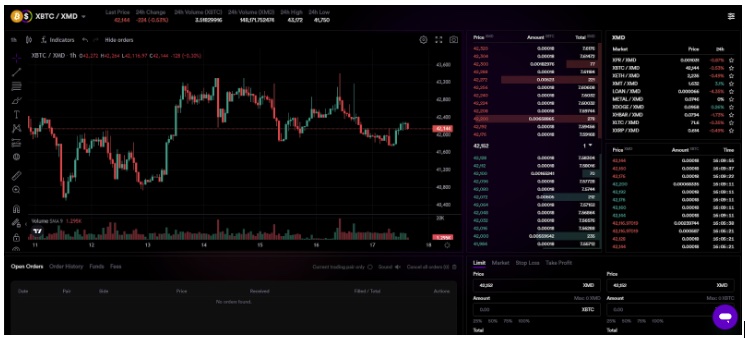
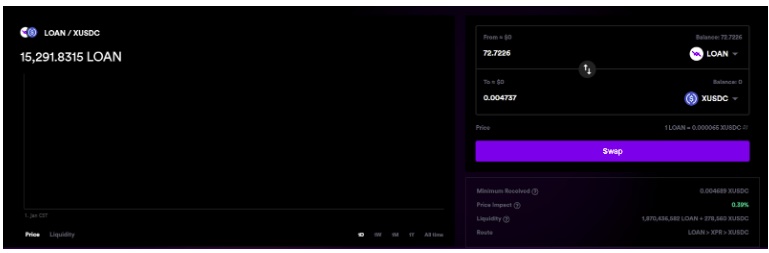
Metal X also supports direct swaps between XPR, USDC, XMT, METAL, BTC, and ETH. This can be quickly and easily done with the web interface or directly in the WebAuth Wallet.
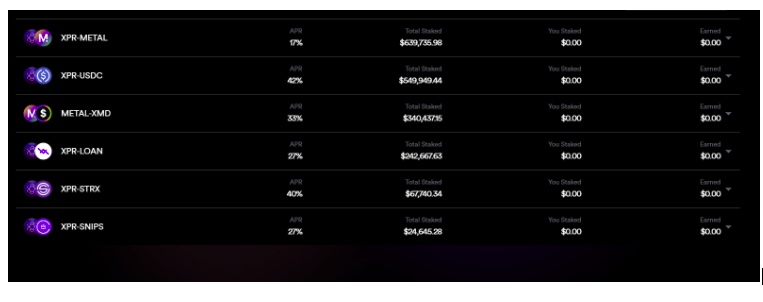
Users can add liquidity to pools for all of the supported tokens on Metal X, earning a percentage of the trading fees for that token pair. Earning percentages vary, with some pools offering better returns than others.
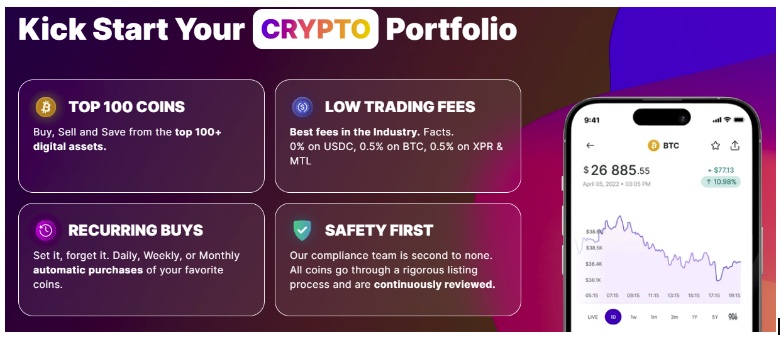
Metal X uses Metal Pay for their fiat on-ramp. This supports debit and credit cards and allows for instant deposits on the XPR network. Purchases through Metal Pay are executed using the Metal X order books, tying the ecosystem closely together.
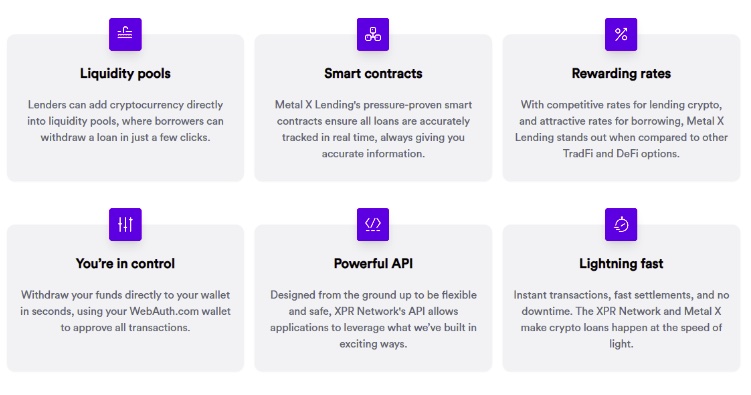
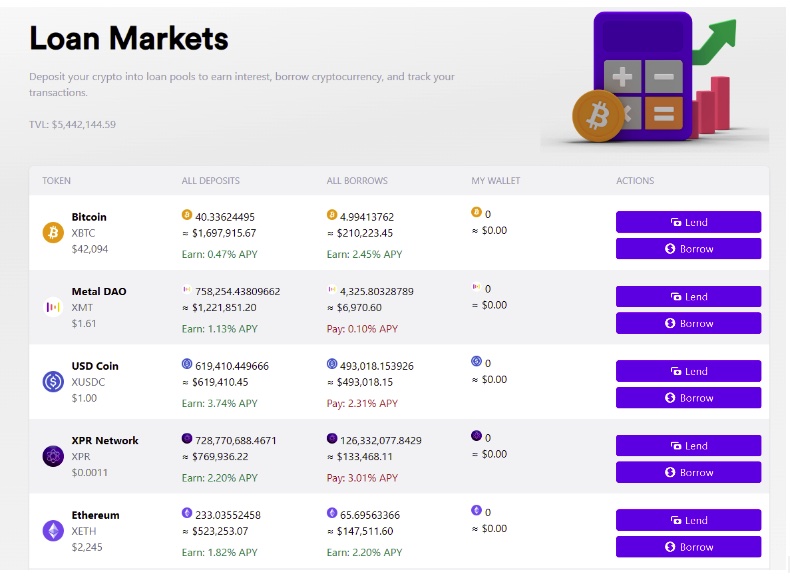
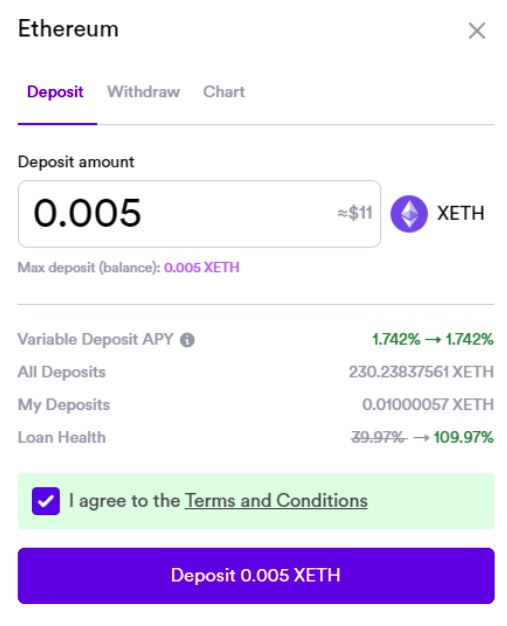
Users can take out loans on the lending portion of Metal X, and they can also add funds to the lending pool, earning interest along the way. Interest is paid in LOAN tokens, which users can swap on Metal X or stake for additional earnings. The lending portion of Metal X is a separate app and will require an additional login to access.
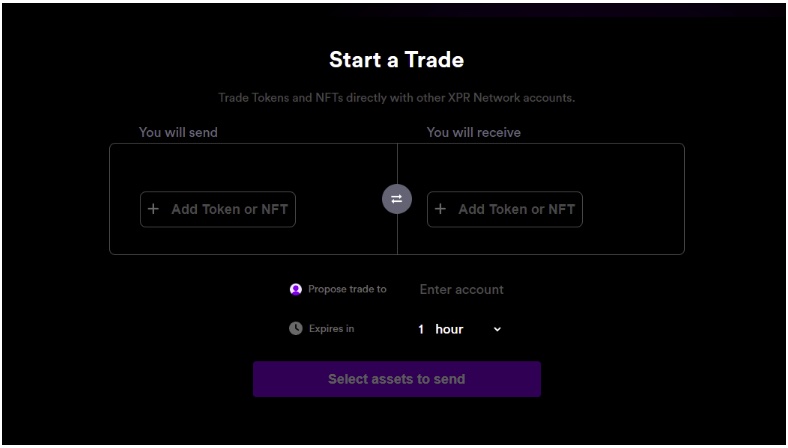
For those who prefer trading directly with other people, Metal X also offers an OTC page, allowing two users to make a trade directly with a visual interface showing the tokens and NFTs that will be transferred by each side. This service is reserved for high-value clients on some platforms, so it’s nice to see this available for everyone on Metal X.
Another interesting feature from Metal X is the option to create streaming payments, transfers to another wallet that occur on a regular basis. This could be used for loan repayments, installment plans, paying for regular services, etc. This isn’t an option that I have seen anywhere else.
There are no network fees on the XPR network. This means you never have to worry about high gas fees during times of heavy network traffic or having a gas fee eat a significant portion of earnings from a trade.
Fees on Metal X vary based on what you’re doing. Basic trades charge 0.1% of the transaction in fees. However, those with large trading volumes or a significant amount of XPR token staked can pay even less.
Loan fees are based on the interest rate at the time. There are no fees associated with adding liquidity or making OTC trades with other users.
And, since Metal X runs on the XPR network, there are no fees charged by the network itself. Transfers, for example, are completely free of charge. And while some transactions will have their own processing fees, there will never be an additional network fee on top of that.
Metal provides a nice, centralized location for most of your crypto financial needs. It lacks a fiat off-ramp and has a relatively small selection of tokens available for trading. But, with a one-stop shop that includes swaps, advanced trading, liquidity farming, OTC trades, loans, and streaming payments, it’s hard not to be excited by the potential.
Getting my wallet set up and authorized on both my phone and through the browser seemed to involve quite a few steps. It wasn’t complicated, but I felt like I was clicking through a lot of screens to get it done. And since the Metal X ecosystem consists of a number of interconnected but separate apps, I sometimes found myself having to log in multiple times when switching between the different features.
But otherwise, the interface is easy to understand, with explanatory text pop-ups for many items. Everything ran smoothly on both desktop and mobile, with no noticeable lag.
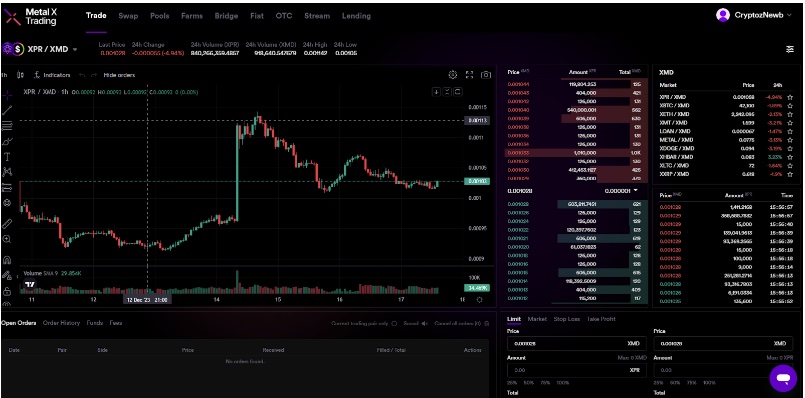
Trading on the Metal X platform requires using XMD or Metal Dollars. This is the stable token for Metal X, backed by a collection of non-algorithmic stablecoins, including USDC, USDT, PAX, and others. Luckily, users can easily swap from any crypto on the platform for Metal Dollars.
Low liquidity is, unfortunately, a concern for Metal X, with some trading pairs holding less than $100 worth of value. But for someone willing to take the risk and provide that liquidity through farms, pools, and loans, there are opportunities to earn passive income while also contributing to the Metal X ecosystem.
Being a decentralized service, Metal X won’t have a full suite of customer service options. They do offer email support, with a quick turnaround, in my experience. In addition, they have an extensive selection of FAQs and docs to help users with questions and understanding the Metal X ecosystem. They also host a Discord server where you can look for help and answers to your questions.
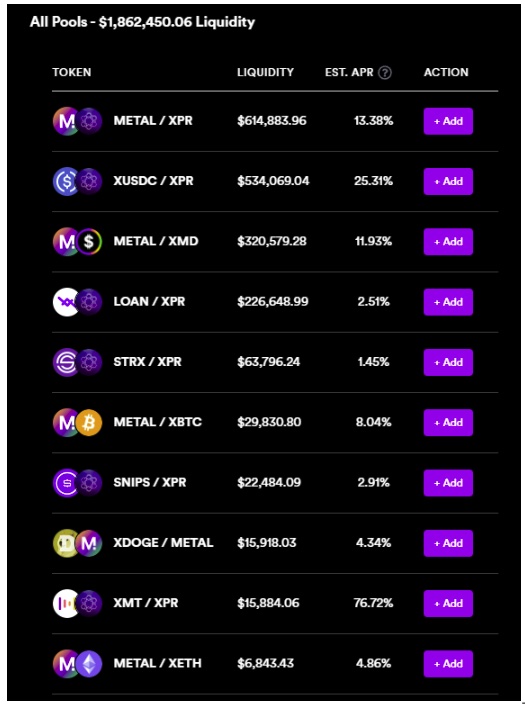
Metal X is not the only financial app in the blockchain world. But they do offer a number of features all in one convenient location. Let’s match them up against a couple of the more popular crypto financial services and see how they compare.
Uniswap is one of the oldest, and perhaps the best-known, decentralized exchanges in the crypto space. And while Uniswap and Metal X share many similarities, there are a couple of major differences.
| Supported tokens | KYC? | Centralized? | Fees | Services | |
| Metal X | Bitcoin Ethereum Litecoin Stellar | Yes | No | 0.1% trading and swap fees; Zero network fees | Swaps Liquidity Pools Farms OTC trades Loans |
| Uniswap | Any tokens on supported networks – Ethereum, Polygon, Optimism, Base, Avalanche, BNB, Celo | No | No | 0.01% to 1%, with most swaps at 0.3% + network fees | Swaps Liquidity Pools |
The main difference between these two options is how you interact with the blockchain. For Metal X, you have to first bridge your tokens onto the XPR network. And while this is a little annoying, it also makes it easy to trade across multiple currencies in one location for no extra fees or hassle. With Uniswap, if you wanted to make a trade for Ethereum and then trade for BNB tokens, you would have to switch networks and pay network fees for every trade as well.
On the other hand, Uniswap doesn’t require any identity verification – yet there are rumors that Uniswap may require a KYC process in the near future as well.
In their favor, Uniswap does allow for the trading of any tokens on their supported chains, making it much more versatile for those who trade in a large variety of tokens.
While Metal X is decentralized, and Nexo is a centralized, custodial-based company, these two crypto-based apps are similar in that they let you keep tokens from multiple blockchains all in one place, allowing for quick and easy swaps, sells, trades, and loans on the platform.
| Supported tokens | KYC | Availability | Fees | Services | |
| Metal X | Bitcoin Ethereum Litecoin Stellar Ripple Dogecoin | Yes | Available everywhere | 0.1% trading and swap fees; Zero network fees | Swaps Liquidity Pools Farms OTC trades Loans |
| Nexo | Bitcoin Ethereum BNB 500+ tokens | Yes | limited in United States | 0.2% trading fees; no fees for crypto deposits or fiat purchases; network fees for withdrawals, though users can get free withdrawals by holding NEXO tokens | Buy and sell crypto Fiat on and off-ramps Loans Staking |
Nexo is a centralized exchange that supports a similar selection of tokens and services as Metal X. You will need KYC for either. Nexo has a bit of an advantage in that it offers a fiat off-ramp and also supports a much wider range of tokens. However, not all of their services are available in the United States. Also, Nexo is a custodial service, meaning that they hold your tokens for you. Metal X is decentralized, so your tokens always remain in your personal wallet until you’re ready to use them.
Metal X uses secondary authorization for most transactions. This can be your mobile WebAuth Wallet, MetaMask, or a device verification system such as Windows Hello.
Metal X is a decentralized service, so aside from making your crypto available for liquidity pools or loans, your tokens will always stay in your wallet and can be bridged out or transferred at any point. You can also withdraw from liquidity pools and loans with a quick transaction.
Metal X, the WebAuth Wallet, Metal Pay, and even the XPR chain are all built by the same company, Metallicus. So there is definitely a requirement to trust that they aren’t being evil. But with a fully revealed C-team, and an advisory board consisting of a former reserve bank leader, a former deputy comptroller, and a former chief compliance officer, it seems clear that Metallicus is serious about making themselves a trusted center for crypto-related financial services.
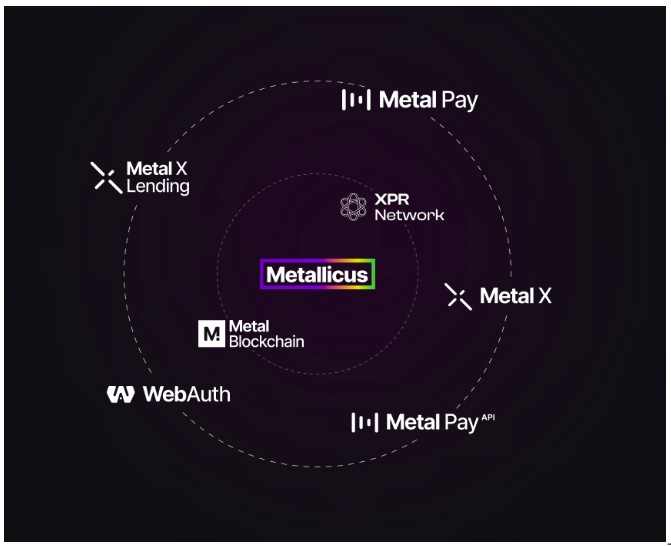
Metal X is built by Metallicus, the team behind the WebAuth Wallet and the XPR network itself. The founders of Metallicus are Marshall Hayner and Glenn Mariën.
Marshall Hayner is known for his involvement in several crypto-related projects, including Stellar and the creation of the first Facebook Bitcoin wallet. He is also a board member of the Dogecoin Foundation.
Glenn Mariën is a full-stack developer who created Dogechain.info, the first online wallet for Dogecoin.
Originally built as a centralized exchange, Metal X shut down in May of 2021 and was retooled as a decentralized exchange and selection of financial services in 2022.
Metallicus, creator of Metal X, was founded in 2016 and is headquartered in San Francisco, California, United States.
Since Metal X is a decentralized platform, all of the tokens locked into it are held by smart contracts. Every token is accounted for programmatically and managed by the smart contract until withdrawn to a personal wallet. So, there are no ‘reserves’ on Metal X because none are needed.
Though I was a bit put off at first about having to bridge my tokens before I could use Metal X or the WebAuth wallet, I was impressed by the availability of several financial services all in one location and the ease of use of the site. The fact that there are no network fees gave me a chance to experiment with the different services without having to pay gas fees for each transaction.
Liquidity on Metal X is a little low at the moment, leading to interesting opportunities such as being able to earn interest by taking out a loan in Bitcoin! If they aren’t able to bring in enough funds to solve this liquidity issue, they may have trouble attracting additional users.
But, as a new platform, they have already hit the ground running with a slew of features, a professional yet easy-to-use interface and a potential trader’s haven with various earning opportunities and no gas fees.
No, Metal X is a selection of decentralized financial services for crypto users. It supports cryptos from a number of different blockchains in one central location, but the service itself is decentralized.
Metal X is on the XPR network (formerly known as Proton). XPR is built specifically to facilitate financial services, offering gas-free transfers and speedy transaction times.
No. Metal X is built and maintained by Metallicus, the company behind the creation of the XPR network. Metallicus is a private company, though they are fully transparent about their team and advisory board.
XPR Network is a layer one blockchain that was formerly known as Proton Chain. After rebranding in 2020, XPR Network has built itself as a blockchain geared for heavy financial use, supporting zero-fee transfers and up to 4000 transactions per second. They have also worked on making themselves ISO2022 compliant, a requirement for any serious financial business.
BTCC Exchange Review 2026: Fees, Pros, Cons, & Safety
BTCC lets you trade crypto, gold, stocks, and more with up to an insane 500x leverage—and it’s been running since 2011 without a single hack.
🚨You can thank us later for this 👇 If you currently hold $BTC, $ETH, $SOL, $XRP, $BNB, $AVAX, $ADA and/or $BAT, you’re probably eligible for the Midnight ($NIGHT) airdrop. 👉 And claims will go live in the month of August, here! Putting crypto inside a Self-Directed IRA (SDIRA). “Ok, cool. I love an airdrop… but…
Learn about the pros, cons, and best features of Bitwave for enterprise crypto tax accounting services
With Arch Lending, borrowers can borrow in USD and stablecoins with almost a dozen cryptocurrencies supported.
Join 330,000+ subscribers and get our 5 min daily newsletter on what matters in crypto.